20 November, 2020

Quora Answer: Why Does Singapore Escape Criticism in the Media When It Comes to Rejecting the Rohingyas?

The following is my answer to a Quora question: “Why does Singapore escape criticism in the media when it comes to rejecting the Rohingyas? 

Singapore has an unambiguous position about accepting refugees: we do not take them in.  This was not always so.  In 1975, with the fall of Saigon, Singapore was inundated with thousands of Vietnamese refugees.  This was a Singapore just a decade from independence, a developing country of limited resources.  She certainly did not have the space to take them all in permanently, and neither did these refugees want to be in Singapore.  They hoped to move on to Australia, the US, Canada, and elsewhere in the developed world. 

In the beginning, Singapore worked with the Office of the United Nations High Commissioner for Refugees (UNHCR), and had an agreement to provide these refugees with temporary care, and housing while the UNHCR arranged permanent resettlement elsewhere.  This was done in good faith.  In the meantime, the number of refugees kept increasing, from the initial political refugees to the later economic refugees, all seeking a better life.  This peaked in 1979, 1980; but boat people were found well into the 1990s.  By that period, it was not just Vietnamese but Cambodians, and some Laotians.  In 1989, the Steering Committee of the International Conference on Indochinese Refugees held a conference in Geneva.  All the countries of ASEAN, except Brunei, were present.  After a contentious meeting, Singapore and all first asylum countries adopted the Comprehensive Plan of Action, which classified further boat people as asylum seekers and not refugees, until they were screened and classified as such. 

Singapore’s transit camp, such as Hawkins camp, were full, and space was rapidly running out.  With this new policy, later arrivals were no longer guaranteed resettlement.  At the same time, many of the second asylum countries reneged on their agreements and refused to take in most of these refugees.  The camps became the home of rejected asylum seekers.  This lead to violence, protests, and attempted suicides; further stressing the government.  This was why we have a hardline refugee policy.  By the middle of 1996, the Hawkins Road Camp was officially closed.  Between 1978 and 1996, a total of 32,457 Vietnamese refugees had stayed there.  While many of them did manage to get resettled in places such as the United States and Australia, most of them were paid by the Singapore government to go home. 

Since then, Singapore does not take in any refugees.  They are given food, water, and fuel, and they are towed to sea, away from our territorial waters.  In the early days, this was a death sentence to some groups because the boats were hardly seaworthy.  In that, we could have done better.  This was Operation Midnight Owl, by the Marine Police and the Republic of Singapore Navy.  Picket lines were set up at sea to intercept these boats before they reached shore. 

Now, when it comes to the Rohingya, Singapore has not encountered any refugees.  Most boats coming south and east end up in Malaysia and Sumatra, Indonesia.  The Malacca Straits is far too busy for them to get all the way south to Singapore without being detected by maritime patrols from Malaysia and Indonesia.  Malaysia is a favoured destination since Malaysia is known to take in refugees, and Malaysia is a Muslim-majority country.  In the event that Singapore maritime patrols do detect such votes as they approach Sultan Shoal, they would abide by our policy of detaining them at sea, providing food, water, and fuel as per UN guidelines, and have them towed out of our territorial waters.  Under no circumstances would we be accepting them.


A Brief on Keyman Insurance

 Keyman insurance is meant to help a business recover from the loss of its valuable assets, or access to key customer demographics, viz the persons who manage it or possess the knowledge.  Every business has a few valuable employees who contribute significantly to the running and growth of the company.  They factor into the valuation of the business by investors and creditors. 

Keyman insurance can be defined as an insurance policy where the proposer as well as the premium payer is the employer, the life to be insured is key employee, and the benefit, in event of a claim, goes to the employer.  The object of keyman insurance is to cover the life of a keyman in case of untimely death, or any form of incapacity; or loss incurred by actions by the keyman.  It is meant to mitigate the monetary impact of these events.


19 November, 2020

Covid-19: Important Updates on AIA Shield Coverage

From 20th October 2020, the Ministry of Health has lifted the exclusions in MediShield Life (MSHL) and Integrated Shield Plan (IP) coverage for COVID-19 related inpatient costs for patients who travelled against advisory, and left Singapore on or after the 27th March 2020. 

With the lifting of the exclusion, persons insured under AIA HealthShield Gold Max who are admitted to hospitals for inpatient COVID-19 treatments on or from 20th October 2020, will be allowed to claim under the policy, subject to the policy conditions. 

Frequently Asked Questions (FAQs)

1. If the Insured is travelling outside Singapore on or from 20th October 2020, does AIA HealthShield Gold Max pay for admission due to COVID-19 in Singapore or overseas?

Yes it does, subject to the policy conditions. 

2. If the insured travelled before 20th October 2020, but under the Reciprocal Green Lane and Special Green Lane Fast / Green Lane arrangements, or has been granted the approval for the travel by the MOH, does AIA HealthShield Gold Max pay for admission due to COVID-19 in Singapore or overseas?

Yes it does, subject to the policy conditions. 

3. Will I be able to claim under my AIA HealthShield Gold Max’s Emergency Overseas (Outside Singapore) Medical Treatment Benefit if I am hospitalised overseas due to COVID-19, having left Singapore from 27th March 2020, in violation of MOH’s travel advisory?

Yes, provided you are admitted to hospitals for inpatient COVID-19 treatments on or from 20th October 2020, and subject to policy conditions.


05 November, 2020

Foreign Word of the Day: Putaria

There are words we need to borrow from other languages.  From Portuguese, that word of the day is “putaria”.  The word is derived from “puta”, which is a derogatory slang for “prostitute”, “whore”, “harlot”, or behaviour related to it.  Putaria” has evolved from referring to whorish behaviour relating to acts beyond sex, such as politics, the celebrity culture, and the need to be famous. 

It is a noun, so you could say, for example, “The current American presidential elections is a putaria of American politics, celebrity worship, and values.”


04 November, 2020

Foreign Word of the Day: Komerobi

There are words we need to borrow from other languages.  From Japanese, that word of the day is “komerobi”.  The word is a compound of (ko), meaning “tree”; and 漏れ (more), meaning “leaking, coming through”.  (ko) is the ancient combining form of modern (ki).  Komorebi refers to the interplay between light and leaves when sunlight shines through trees.  More than a phenomenon, it describes a specific melancholic longing, or nostalgia for a person, place or thing that is far away. 

It is a noun, so you could say, for example, “The komerobi as we walked through the forest made me imagine that the veils between our world, and the world of faeries are thin, and I could almost imagine a unicorn in the glade.”


03 November, 2020

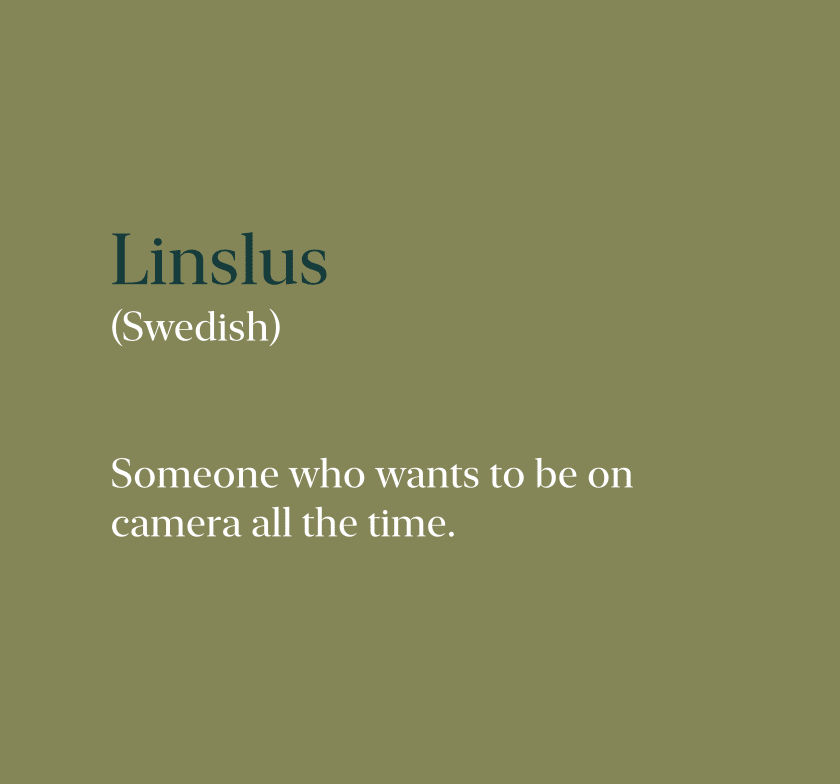
Foreign Word of the Day: Linslus

There are words we need to borrow from other languages.  From Swedish, that word of the day is “linslus”.  This is a portmanteau of two words.  It is from “lins”, meaning “lens”, and “lus”, which is a “louse”.  This is thought to be a loan word since it is derived from English, and is a play on shutterbug.  The difference here is that the “lens louse” is on the other end of the camera.  Linslus” is a person who is a slut for the camera, and puts great effort in appearing in photographs. 

The word has been used, at least, since 1973.  It is a noun, so you could say, for example, “The linslus at the wedding wanted to interject herself into every picture even though she was not close to the wedding couple.”


Foreign Word of the Day: Bifler

There are words we need to borrow from other languages.  From French, that word of the day is “bifler”.  This is a portmanteau of two words.  It is from “bite”, a vulgar slang for the penis, and “gifler”, meaning “to slap”.  Therefore, “bifler” is refers to the act of slapping someone with your penis. 

Bifler” is an intransitive verb, so if we were to borrow it for English, you could say, “He deserves a bifler just for his attitude.”